
At Dropmore, we use the White Rose Scheme of work to teach maths, supported by Master the Curriculum.
White Rose teaches children mathematical concepts through concrete, pictorial, practical and abstract methods in order to develop a deep understanding, confidence and competence in Maths and improve fluency. Fluency in Maths is about developing number sense and being able to choose and use the most appropriate method for the task at hand and be able to apply a skill to multiple contexts.
Content is carefully sequenced through the year groups according to the mathematics progression map, which shows how each area of mathematics progresses as children get older.
Concrete
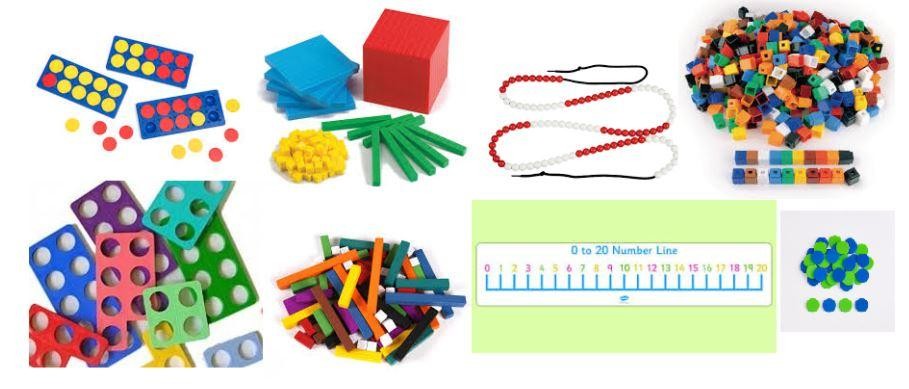
Children first learn skills using concrete objects to demonstrate their understanding. This is done through using a range of concrete resources represented in different ways linked to the learning objective.
Examples of some of the concrete equipment we use is found below:
Pictorial
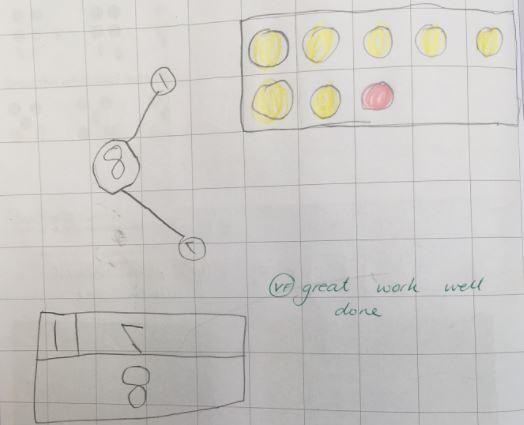
After learning skills using concrete objects, children learn pictorial methods of representing their work to show their thinking processes. Pictorial is the “seeing” stage, using representations of the objects to model problems. This stage encourages children to make a mental connection between the physical object and abstract levels of understanding by drawing or looking at pictures, circles, diagrams or models which represent the objects in the problem.
Abstract
Only once a child has demonstrated that they have a solid understanding of the “concrete” and “pictorial” representations of the problem, the children are introduced to the more “abstract” concept, such as mathematical symbols. Children are introduced to the concept at a symbolic level, using only numbers, notation, and mathematical symbols, for example +, –, x, / to indicate addition, multiplication, or division. e.g. 6 + 1 = 7 ; 9 - 5 = 4 ; 20 x 2 = 40
Only once a child has demonstrated that they have a solid understanding of the “concrete” and “pictorial” representations of the problem, the children are introduced to the more “abstract” concept, such as mathematical symbols. Children are introduced to the concept at a symbolic level, using only numbers, notation, and mathematical symbols, for example +, –, x, / to indicate addition, multiplication, or division. e.g. 6 + 1 = 7 ; 9 - 5 = 4 ; 20 x 2 = 40